Ultimate Cribbage: Card Board
WildCard GamesCard
4.416.54K Reviews
- Version
- 2.9.6
- Installs
- 1.00M
- Age Rating
- Everyone
Screenshots
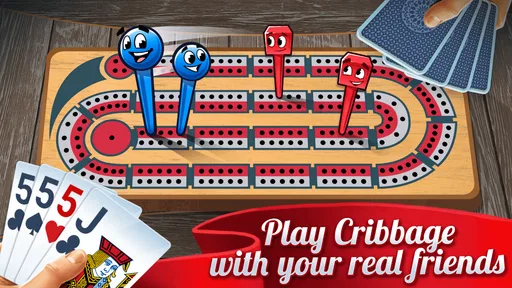

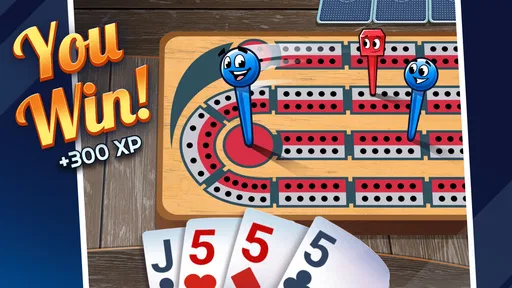

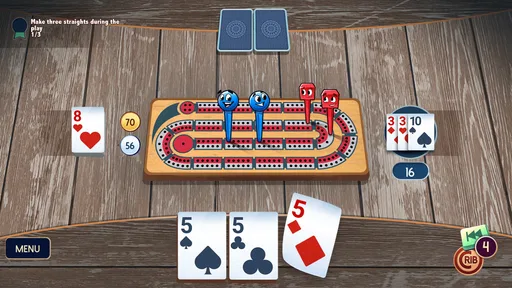
Our Review of Ultimate Cribbage: Card Board
 Analysis by Appyee
Cribbage can look intimidating when you first sit down with a board, a hand of cards, and a scoring system that seems to have its own language. Ultimate Cribbage: Card Board is a free card game from WildCard Games that makes the format easier to approach on a phone or tablet. I found its appeal less in flashy presentation and more in how quickly it lets you get into the rhythm of choosing cards, building combinations, and trying to reach the finish before your opponent.
This is a digital version of cribbage, not a collection of unrelated card games. That focus is useful if you already enjoy the tabletop game and want a convenient opponent, but it also means the learning curve matters. A first-time player should not expect to understand every scoring decision immediately. The good news is that each hand gives you a small, manageable problem: decide what to keep, decide what to discard, then make the best of the cards that appear during play.
I would recommend it to someone who wants a thoughtful card game for short sessions rather than a fast reflex challenge. It is rated for Everyone, costs nothing to install, and has become a widely used choice, with an average rating of 4.4 from around 91 thousand ratings and more than a million installs. Those figures suggest a healthy audience, but they do not remove the need to learn the rules. Cribbage rewards attention, and the app is most enjoyable once the basic scoring stops feeling like homework.
What the first game feels like
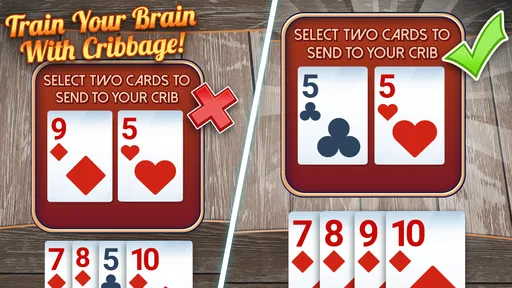
The central loop is straightforward once you understand the purpose of the crib. You receive cards, keep the ones that work best together, and place the others into the crib. The crib is scored later, and who receives it changes the value of your discard. That single decision gives the game more depth than a simple “make the highest hand” card game.
For a beginner, the first meaningful success is not necessarily winning. It is recognizing why one discard is safer or more valuable than another. A pair may be tempting to keep, while a connected sequence can create several scoring possibilities. A card that looks weak in your hand can also be dangerous to give away if the other player gets the crib. I found that thinking about both parts of the hand—what I keep and what I might be handing over—made the game click faster.
The board-style scoring is also important. Cribbage is normally played toward a target of 121 points, with players moving pegs as they score. In the app, that progression gives every hand a place in the larger match. A poor hand does not automatically ruin the game, and a strong opening does not guarantee victory. You are constantly balancing immediate points against the position you want to reach later.
That makes the game a good fit for a commute, a quiet break, or an evening when I want something more involving than a matching game but less demanding than a long strategy title. A single hand can be considered in small pieces, so I do not need to memorize a complicated campaign or prepare a large deck before playing.
Why the crib changes everything
New players often focus only on the cards they keep. I made that mistake too. The discard is not merely a way to remove two unwanted cards; it is part of the opponent’s potential score. If I give away cards that work well together, I may be improving the rival hand even when my own hand looks excellent.
A practical beginner habit is to examine the discarded pair as if it belonged to the other player. Ask whether the cards form a pair, sit close together, or combine easily with common starter cards. This does not mean you should always throw away disconnected cards. Sometimes protecting your own scoring opportunities matters more, especially when you are behind. The useful lesson is that every discard has two sides.
The dealer’s position adds another layer. The player who receives the crib gets an extra scoring opportunity, so the same hand can lead to a different decision depending on whose turn it is. I would not try to memorize every strategic rule before starting. Instead, I recommend noticing this relationship during play: when you deal, you want to build your hand while limiting the crib; when you do not deal, you want to keep your own combinations without donating an easy bonus.
Getting through the first setup without overthinking
After installing the game, I would begin with a relaxed session rather than trying to play perfectly. The current version is 2.9.6 and requires Android 8.0 or later, so the main practical check is whether the device meets that system requirement. The game is free, although optional in-app purchases range from $0.99 to $99.99 per item. I would treat those purchases as a separate choice rather than something needed to understand the card play.
On the first launch, take a moment to identify the hand area, the cards being discarded, the starter card, and the scoring board. The most important visual question is not how attractive the interface is; it is whether you can tell which cards belong to your hand and which cards have already been committed. If you are unsure, slow down before confirming a discard. In cribbage, a rushed tap can change the whole hand.
I also suggest keeping a simple mental checklist for the opening deal:
- Look for pairs, runs, and cards that can combine in several ways.
- Separate cards that score together from cards that only look individually valuable.
- Consider whether the discard would create an easy crib for the opponent.
- Remember that the starter card may improve combinations after the discard is complete.
This routine is more useful than trying to calculate every possible score at once. It gives a new player a repeatable process and reduces the feeling that every decision requires expert knowledge.
The first successful action to aim for
For me, the first satisfying breakthrough was spotting a hand with more than one scoring route. A pair is obvious, but a group of connected cards can produce a run, and cards of the same rank can sometimes support additional combinations. The best beginner hands are not always the ones with the highest visible cards; they are the ones that remain useful when the starter card changes the situation.
When you receive a hand, try arranging the cards by rank rather than looking at them in the order shown. Then compare possible groups. One arrangement may offer a strong pair, while another may create a sequence with several scoring possibilities. You do not need to find the mathematically perfect choice to make progress. You only need to notice that the cards can be evaluated as groups rather than as isolated values.
During the play phase, pay attention to the running total. Players take turns laying cards while keeping the combined count within the limit of 31. This phase feels different from scoring the completed hand because you are trying to create points without giving the other player an easy response. Holding a card for later can be better than playing the card with the largest immediate value.
A useful first-game goal is to create one scoring opportunity while denying one obvious reply. For example, instead of automatically playing a card that brings the count close to the limit, consider whether it lets the opponent complete a pair or reach a valuable total. This small pause turns the play phase from simple card placement into a conversation between two hands.
Common confusion that can make cribbage seem unfair
The scoring system is the biggest barrier. Points can come from pairs, runs, combinations that total fifteen, and other relationships among the cards. A hand that looks ordinary can score surprisingly well, while a collection of high cards may be less useful than expected. I found it helpful to treat the first few matches as practice in reading the scoring logic rather than as a test of intelligence.
The starter card is another frequent source of confusion. It is not part of the cards you choose to keep or discard, but it can affect the scoring of both the player’s hand and the crib. That means your decision is made before you know the final card that will be added. This uncertainty is not a flaw; it is one of the reasons cribbage remains interesting. You are choosing a flexible hand rather than guaranteeing a result.
Players also sometimes assume that the visible score tells the whole story. In cribbage, the order in which points are counted matters strategically, especially when one player is close to the winning position. The app’s board presentation makes the match easier to follow than keeping paper notes, but I still recommend watching the score after each hand and thinking about who gets to count next.
Another point that takes time is the difference between a promising hand and a safe discard. If you are the non-dealer, giving the opponent a low-risk crib can be worse than accepting a slightly weaker personal hand. If you are the dealer, you may accept more risk because the crib comes back to you. These are not rigid rules, and the right choice changes with the score. Early in a match, building potential can be sensible; near the end, preventing a decisive swing may matter more.
Small habits that improve results
The first advanced habit I recommend is counting combinations instead of relying on card rank alone. A five is valuable because it can help form fifteen with many cards, but its usefulness depends on the rest of the hand. Likewise, low connected cards can be stronger together than a high card that has no partner. Before discarding, look for the number of ways each group could score after the starter appears.
The second habit is to watch the opponent’s play during the count. Cards played close together may reveal an attempt to create a pair or a run. You cannot know the hidden hand, but you can avoid handing over easy responses. If the running total approaches 31, think about which card you want available for the next exchange rather than spending every useful card immediately.
The third is to adjust your risk according to the board position. When you are comfortably ahead, limiting the opponent’s crib may be more valuable than chasing a spectacular hand. When you are behind, a conservative approach may simply postpone the loss, so taking a chance on a stronger combination can be reasonable. This is where the app becomes more than a rule-learning tool: it gives you repeated opportunities to practice decisions under changing pressure.
A fourth useful technique is to review the hand after it is scored. Do not only ask whether you won the hand. Ask which discarded card helped or hurt, whether the starter changed your plan, and whether you missed a pair or run. This quick review makes each match a lesson and is especially helpful for players who do not have an experienced cribbage partner nearby.
How it compares with other ways to play
Compared with a physical cribbage board, the app is faster to start and easier to use when nobody else is available. There is no need to find a deck, track pegs manually, or remember where the score was left. That convenience is the strongest reason I would choose it for solo practice or casual play.
A real board still has advantages. Face-to-face cribbage carries social energy that a screen cannot fully reproduce, and handling the cards makes the game feel more tactile. If your main goal is a relaxed evening with a partner or family member, a physical deck may be the better choice. The app is more useful when convenience, repetition, and immediate access matter most.
Compared with simpler card games such as solitaire, this one asks for more deliberate decisions and offers more room for improvement. Solitaire is often better when you want a quiet puzzle with no opponent. This game is better when you want to read another player’s possible intentions and make choices that affect both your score and theirs.
It is also different from fast multiplayer card games that depend on constant action. Cribbage gives you time to consider a discard and learn from the result. That makes it approachable for thoughtful players, but anyone looking for rapid rounds, dramatic effects, or a large variety of modes may find the focused design too narrow.
Who should install it, and who should skip it
I think this game is a good match for first-time cribbage players who want a low-pressure way to learn the structure of a hand. It is also suitable for experienced players who need a portable practice option, especially when they want to work on discards and counting rather than setting up a full tabletop game.
It is less suitable for someone who dislikes score-based card games or becomes frustrated by rules that are not immediately obvious. The app cannot remove the underlying complexity of cribbage. If you want a game that explains itself in seconds and rewards random play, this is probably not the right download.
Players who are sensitive to optional spending should also decide on a personal boundary before playing. The game itself is free, while individual in-app purchases can cost from $0.99 up to $99.99. I would not make a purchase simply because a match went badly; the core improvement comes from understanding the hand, not from trying to buy a better result.
The Everyone age rating makes it a reasonable choice for a broad audience, but younger players may still need help with the scoring concepts. I would introduce it by playing alongside them and explaining one idea at a time: first pairs, then fifteens, then runs. That approach is less overwhelming than presenting the entire rule set in one lesson.
What a realistic daily session looks like
Imagine having ten quiet minutes before an appointment. I would open the game, play a hand or two, and focus on one skill rather than trying to complete a perfect match. On one session, that might mean avoiding generous discards. On another, it might mean watching the running count and saving a useful card for the closing play.
That kind of focused practice is where the app works best. It turns spare time into repetition without requiring a large commitment. If I lose, I can still identify a decision to revisit. If I win, I can check whether the victory came from a strong hand, a fortunate starter, or better control of the crib. The result is more satisfying when I understand why it happened.
For a family setting, I would use the app as a teaching aid rather than a replacement for a physical game. Show a new player the cards on screen, pause before the discard, and ask what they would keep. Then compare the actual score with the prediction. This makes the scoring system concrete and gives beginners a reason to think through the choice.
My final recommendation after learning the rhythm
The best reason to try Ultimate Cribbage: Card Board is that it makes repeated cribbage practice convenient without stripping away the decisions that make the game worthwhile. Its free entry point, Everyone rating, and established audience make it easy to approach, while the focused card format gives it more substance than a throwaway time-filler.
My advice is to begin slowly, accept that the first hands may feel confusing, and judge progress by the quality of your decisions rather than by immediate victories. Learn to examine the crib, look for flexible combinations, and adapt your risk to the board. Those habits will help whether you continue playing on your phone or eventually move to a physical board.
WildCard Games has kept the experience centered on the classic card challenge, which is both its strength and its limitation. You are not downloading a broad arcade package or a constantly changing collection. You are choosing a dedicated cribbage game. If that is what you want, it is an accessible place to start and a useful companion for improving over time. If you need fast action, extensive variety, or a strongly social tabletop atmosphere, another type of card game will serve you better.
Verdict
Strengths of Ultimate Cribbage: Card Board
- Clear scoring system makes it easy for beginners to learn cribbage.
- Several difficulty levels provide a suitable challenge for different players.
- Quick matches work well for short gaming sessions.
- Offline play lets you enjoy matches without an internet connection.
- Traditional rules and board-style scoring preserve the classic cribbage feel.
Limitations of Ultimate Cribbage: Card Board
- The interface may feel dated compared with newer card game apps.
- Higher difficulty levels can sometimes seem overly predictable.
- Limited customization reduces personalization of boards and cards.
- Ads may interrupt play unless removed through an in-app purchase.
- The game offers little variety beyond standard cribbage matches.
Other Releases by WildCard Games
View All


Similar Picks in This Category
View All
Solitaire - Classic Card Games
MobilityWare4.6

UNO!™
Mattel163 Limited4.3

Spider Solitaire: Card Games
MobilityWare4.6

Solitaire.com - Classic Cards
Tripledot Studios Limited4.7

Plants vs. Zombies™ Heroes
ELECTRONIC ARTS4.1

Hearthstone
Blizzard Entertainment, Inc.4.1
Frequently Asked Questions
What is Ultimate Cribbage: Card Board, and how is the game played?
Ultimate Cribbage: Card Board is a digital version of the classic cribbage card game, combining traditional scoring with a board-style interface. Players aim to reach the target score before their opponent by creating valuable card combinations during play and in the hand-counting phase. The app is designed to make the rules, pegging, scoring, and progress easy to follow, even for newcomers.
Is Ultimate Cribbage: Card Board suitable for beginners?
Yes, the game can be a good choice for beginners, especially if you have never played cribbage before. The digital format helps manage card dealing, pegging, score calculation, and board movement automatically. However, new players may still need a little time to understand concepts such as the crib, fifteens, pairs, runs, and counting the starter card. Learning the scoring system is part of the experience.
Can I play Ultimate Cribbage: Card Board offline?
Offline availability may depend on the specific version, device, and features you want to use. Core single-player gameplay is generally the most likely mode to work without a continuous internet connection, while online matches, advertisements, updates, or certain competitive features may require access to the internet. It is best to check the app-store description and test the game after installation if offline play is important.
Does the game include multiplayer or competitive options?
Ultimate Cribbage: Card Board may offer ways to play against computer-controlled opponents and, depending on the release, potentially other competitive modes. Before downloading, check the current store listing to confirm whether online multiplayer, local play, leaderboards, or challenge modes are included in your version. Multiplayer availability can vary between Android and iOS editions and may require an internet connection or an account.
Are there purchases, advertisements, or privacy concerns in the app?
As with many free-to-download card games, Ultimate Cribbage: Card Board may include advertising, optional purchases, or both. These can differ by platform and may change through updates. Before installing, review the Google Play or App Store listing for pricing, in-app purchase details, permissions, and the developer’s privacy policy. Pay particular attention to whether data collection, personalized ads, or account registration is required.
Play our best games!


